
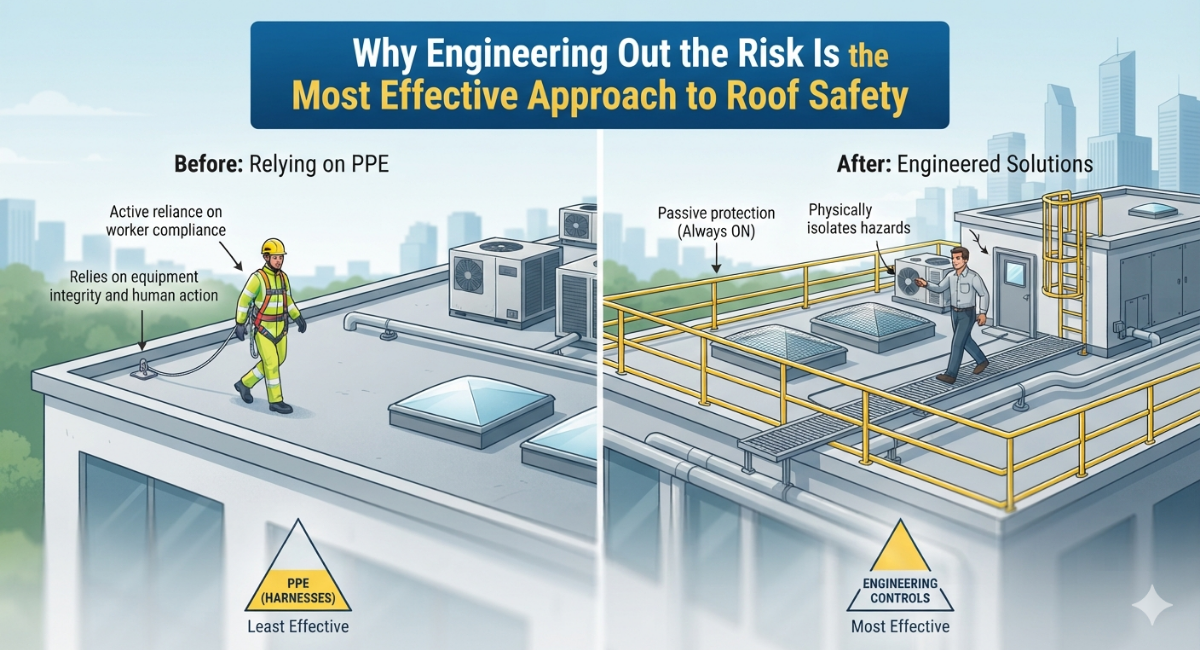
The order we should follow to keep people free from harm is: first, try to eliminate the hazard or the risk of falling at all; then work to substitute the hazard (the fall) for something less severe; next try to safeguard workers in case the hazard can’t be controlled; and only as a last resort give them gear to protect themselves. So what exactly does that look like in practice on a construction site?
The hierarchy of controls isn’t a suggestion
Every reputable safety organization has the same hierarchy of controls. Each of them groups controls in the following order:
1. Eliminate the hazard.
2. Substitute something less hazardous.
3. Isolate people from the hazard.
4. Engineer controls to isolate people from the hazard.
5. Change people’s behavior through administrative controls.
6. Equip people with PPE.
Roofing is dangerous enough that most seasoned safety managers extend that hierarchy even further. To avoid roof work, they’d rather invent alternative products and systems that don’t require workers to be exposed, but those are rare. For the most part, if you’re roofing, you’ve got to be up on a roof. So after all else fails, tackle the problem at its source.
Why training and paperwork keep failing on their own
Using Safe Work Method Statements, toolbox talks, warning lines, and perimeter signage to manage safety on the roof may seem like a great idea. After all, this isn’t your first walk around the block. You’ve made your workers aware of the dangers and stayed on top of mandatory requirements. This box is well and truly ticked.
But those controls didn’t physically stop your worker standing on a fragile surface and toppling off the edge. They didn’t come between them and a bad decision. They relied on your worker doing the right thing when the warning lines were still three steps away and the task was just over the edge.
When you rely on people to be your last line of defense – instead of the last line of defense relying on people – you’re fighting an unwinnable battle. The deck is stacked against your workers. We’re not robots, and no amount of training, SWMS, or self-discipline will keep us from occasionally making dumb or human decisions. Especially in the rush of a real-world work environment where the clock is ticking and productivity is king.
PPE limits injury, it doesn’t prevent falls
People often think that harnesses, lanyards, and anchor points are the most critical components of fall protection. That’s inaccurate. A harness can’t prevent a fall. It can only prevent a fall from proving fatal, as long as it’s being used properly, attached to a compliant anchor point, and the worker is positioned within the required travel limits.
Those are a lot of conditions to be met. The lanyard isn’t attached correctly, the anchor point is rated for the incorrect load, the worker goes outside the designated travel area – take your pick. One mistake and you go from having a “protected” worker to an “unprotected” one, and no one knows the difference until a fall happens. PPE is the least effective mitigator for a reason. It manages the outcome. It doesn’t manage the risk.
Roof anchor points and lifeline systems are real engineering controls, and they have their place. But they’re still not much farther along the “act” end of the safety spectrum because they’re only effective when a worker connects properly every single time. And that’s the ultimate single point of failure the hierarchy of controls is designed to eliminate.
Passive protection beats active protection every time
This is the core distinction that separates a roof safety program that actually works from one that just looks good on paper.
Those fixed handrails, guardrails, and perimeter barriers we’ve been talking about? They’re part of what’s known in safety jargon as “passive” protection. A bulky term, but it fits the technology. It doesn’t matter who you are or what you’re doing – that handrail stands between you and the edge whether you’ve just stepped onto the roof for the first time or whether you’re halfway through your shift.
Put your hand up if you’re noticing a pattern here. Passive systems – fixed handrails, guardrails, perimeter barriers – protect everyone on the roof without asking anything of them. No hook-up, no activation, no correct usage required. They work the same way for the apprentice on their first day and the foreman who’s done this job a thousand times. Fatigue, complacency, and bad weather don’t change how a handrail performs.
Active systems are trickier. A harness has to be worn properly. A lanyard has to be attached to a rated anchor before stepping near the edge. A warning line has to be respected even when it’s inconvenient. Every one of these steps is a place where human error can slip through, and on a big enough site, over a long enough timeline, it will.
This is where permanent or temporary edge protection becomes the default engineering solution rather than an optional add-on. Well-designed roof handrail systems create a physical boundary along the roof perimeter that functions regardless of who’s working that day or how the job is going. They don’t rely on a worker remembering anything. They’re just there, doing the one job they’re designed for, whether the crew is on hour one or hour nine of a shift.
Fragile roofs and skylights deserve a specific mention here too. These aren’t hazards that training can manage. A skylight looks like a walkable surface until someone puts weight on it. No amount of toolbox talk changes the physics of a fragile panel giving way. These situations need physical guarding or covers, full stop – they’re a textbook case for why engineering controls exist in the first place.
The lifecycle economics actually favor engineering controls
The argument you hear most against guardrails is the upfront cost. Permanent guardrails and edge protection cost more to install than a training session or a box of harnesses. That’s the end-to-end comparison most decision-makers make, and it’s an incomplete one.
After install cost, the math flips. Lower incidents mean lower insurance premiums over time. It means downtime when a site gets shut down for an investigation. It means injury claims working through the system for months or years. It means a regulator halting work until they’re satisfied with corrective action, which on a live construction schedule can be a higher far cost than the barrier would have been.
Building it in from the start: prevention through design
The most efficient and effective version of any engineering control is the one that’s designed in before a sod is turned or a beam is riveted in place. Roofing is no different.
When stairs and handholds, lighting, and even anchorage points (more anchorages get installed wrong after the fact than just about anything else) are thought of only after the roof is already down, they come in compromised. They are harder to access. They compete for space with ducts, drains, and equipment. They mess with gutters and drain lines… or at least they would if water wasn’t pooling over there because nobody thought to factor in that four percent pitch.
And all these complications tend to increase installation costs for the contractor, meaning safety and efficiency improve at the cost of quality. Which they don’t. Costs pile up, so often the safety team is forced to choose between a solution that reduces injury risk and a solution that’s installed and maintained perfectly to spec – and might just maybe reduce injury risk as a bonus.
What a properly ordered safety program actually looks like
Rules and regulations such as OSHA 1926 Subpart M in the US, and AS/NZS 1891 together with WHS Acts in Australia, have a similar approach, although the details are different. You start with risk evaluation and hazard identification, in order to determine what makes a specific roof hazardous. Then you implement engineering controls, designed to address the specific hazards identified at the assessment stage. On top of that backbone, you implement administrative controls and training, to manage the risk that remains. PPE serves as the ultimate level of protection, meant to cover the risks not addressed by everything else.
However, the majority of worksites get the sequence all wrong. They start with the PPE, because it’s the cheapest and most visible. They add training, because it’s an easy compliance box to tick. They come up with a generic set of warning lines and signs, because that looks good when an auditor comes around. Then, if there’s any budget left, they debate whether the roof edge itself should be considered a hazard necessitating some physical barrier.
Do it in the opposite order, though, and the whole system works better, not worse. Engineered protection, starting with whatever you’re putting on the roof anyway, becomes the level that’s already handling the worst of it, before you even have someone up there working. Training and supervision are then used to cover the smaller, lesser, ‘things go wrong’ type risks that any physical barrier can’t be expected to anticipate. PPE as the last gasp measure it was always supposed to be, for when absolutely everything else has already failed.
For commercial roofing projects, choosing a qualified contractor is also essential for maintaining safety and quality.